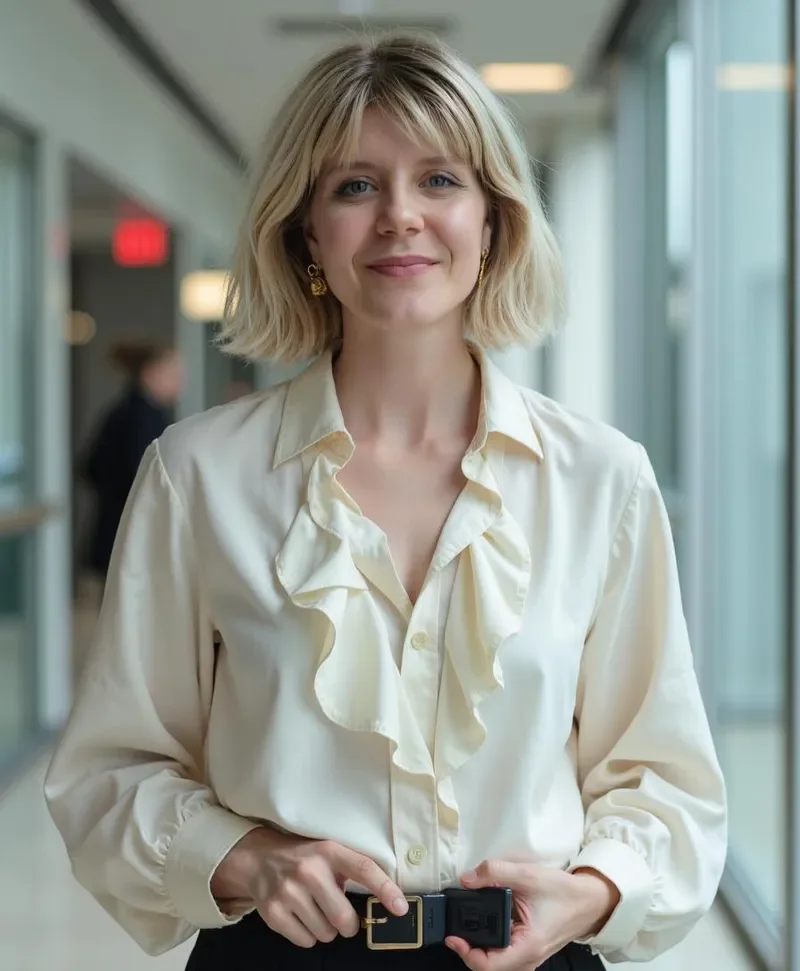
A woman with blonde hair wearing a cream-colored blouse with ruffles, standing in a modern indoor space with large windows and blurred background.

Hi! I’m Elise Marie Leise, a writer & editor specializing in emerging technology.

Over the years, I've worked in digital media, journalism, and executive education, running media projects for Imperial College London, Cambridge, MIT Media Lab, and the University of Oxford.

Now, I consult for a select number of clients and write freelance articles for media and tech companies. I studied cybersecurity and analytics at Georgetown University’s School of Continuing Studies and rhetoric at Middlebury College.


Get in Touch
Read my Substack
  • Technology and writing, a matrix of blue and dark blue light strips.

    The Earthshot Prize: This global prize competition is launching moonshots to save the planet

    In September 1962, when JFK delivered his legendary speech urging the country to pursue a moon landing, it sparked a decade-long mission to take “one giant leap for mankind.” More than half a century later, the Earthshot Prize is aiming to follow suit with another ambitious goal for humanity — but this time, setting our sights on this planet. 

    The idea is that, rather than putting all our bets on one giant moonshot, the competition will fund a multitude of small projects, funneling capital to founders who have a sophisticated understanding of the problems faced by their local community. 

    Dr. Sebastian Groh, the founder of SOLshare and one of the first finalists for the Earthshot Prize, calls this strategy “an army of startups working on climate in the developing world.” An “army of entrepreneurs,” he says, is our best chance at solving critical challenges overlooked by Silicon Valley: tuk-tuk electrification, cleaner air conditioning coolants, alternative heating for cookstoves, and incentives for small-scale farmers to capture carbon in the soil.

  • Anastasia Marchenkova: A million qubits? This quantum advisor isn't buying it.

    Funding for quantum technology is accelerating. Quantum builder Anastasia Marchenkova wants to make sure funders still ask the tough questions and pass her no-nonsense bar for investment.

    After several years of contracting funding, quantum technology is entering a renewed wave of investment. Funding in Q1 of 2025 for quantum companies reached $1.25 billion, roughly double that of the year before, and according to McKinsey, the total quantum market is predicted to be worth ~$198 billion by 2040. In cities as far-flung as Tel Aviv and Tokyo, investors are making a bet that quantum tech will move out of the lab at last. 

    But the challenge of convincing investors to fund quantum research persists. “Scientists have great ideas,” Marchenkova tells me. “And great technology.” But it can be difficult to translate that knowledge into a timely pitch, which is why she’s built a career helping quantum founders communicate the impact of their work. 

  • A city at night in Taipei or Southeast Asia, technology and international relations writing

    Universal basic income in Taipei: The economics of tariffs and artificial intelligence

    “You can never predict when a family will find themselves in financial instability,” Yuling Zhang, an associate professor at the University of California, Berkeley, says in a preview of UBI Taiwan’s recent documentary on universal basic income. Between layoffs, health episodes, caring for aging parents and young children, and now the rise of artificial intelligence, no one knows when their savings might be tapped to cover an emergency from lack of work.

    As a result, UBI Taiwan, along with a wide array of other organisations and advocacy groups around the world, are advocating for some form of universal basic income (UBI), in which a stipend is issued, without restriction, to fund the basic needs of a country’s population. This isn’t the first time UBI has entered the national conversation, in either Taiwan or the U.S.; but as AI continues to reshape the workforce, the conversation is going more mainstream, picking up support from liberal and more central parties alike.

  • Windmills in the ocean, climate change and sea level rise writing article

    Designing the future of VR with extended reality: How video games might shape the future of small island states

    Other than the fact that you’re in an underwater simulation, the world looks incredibly realistic. Bleached reefs; occasional plastic water bottles; Coke cans submerged in the sand. Everything else is relinquished to the ocean, save the crustaceans. Welcome to Aftermath Submerged, one of XR architect Vipin Dhunnoo’s experiments in virtual reality. This is his life’s work: to save his island from rising tides.

    Today, Mauritius is one of a number of small island developing states that includes Antigua and Barbuda, Kiribati, Trinidad and Tobago, the Seychelles, Suriname, Guinea-Bissau, and the Maldives. All of these countries are at risk of submersion, or flooding, as global sea levels rise. Tuvulu, for one, is preparing to upload a digital copy of itself to the metaverse, starting with its smallest island, Te Afualiku. Others are starting to consider how they might also hold onto their physical landmarks as they sink beneath the waves.

    Small island states face a fundamentally different challenge than that of global and cosmopolitan hubs. London, Seoul, Tokyo, Paris, New York, L.A., Berlin, Milan: these cities have little shortage of digital assets. The Eiffel Tower is likely overrepresented in digital libraries; Buckingham Palace and the Berlin Wall will always make it into the metaverse. Small islands like Mauritius, however, lack the luxury of this repository; instead, their digital base must be built from scratch.

A rugged volcanic landscape with steam rising from the ground, colorful rocks, and patches of snow on distant mountains under cloudy skies.

I’m based in Minneapolis, MN, but I work remotely in both the U.S. & the United Kingdom.

I’m especially interested in technology and cybersecurity, geopolitics, global security, leadership in deep tech, and the ethics of artificial intelligence. Most of my projects involve speaking with subject matter experts and writing copy that goes through multiple rounds of revisions.

Curious about working together? You can reach out to me at the links below.

LinkedIn: elisemarieleise

Email: elisemarieleise@gmail.com.

Get in Touch
See my CV